Bridging the Innovation Gap: UP's Next-Generation AI Development Platform
UP launches the Xtreme ARL AI Development Kit, combining 83 TOPS of edge AI performance with industrial-grade design — empowering developers to seamlessly scale from prototype to production.

27 Oct, 2025. 8 minutes read
Despite the rapid evolution of edge AI, a persistent challenge remains: how do engineers move from concept to deployment without getting mired in integration complexity? Under AAEON Technology Europe, UP has spent a decade addressing this question. Rather than focusing on a single board, UP has built a comprehensive AI ecosystem designed to help developers take projects from proof-of-concept to production with ease. Through a combination of ready-to-use hardware, software tools, and partner integrations, the ecosystem ensures developers can quickly scale, deploy, and expand their AI solutions.
At its core is the UP Xtreme ARL AI Development Kit, UP's most powerful platform yet, delivering 83 TOPS of AI performance within an industrial-grade, compact form factor. But the ecosystem extends far beyond a single board. It encompasses tiered hardware options for different performance needs, pre-integrated software suites that eliminate setup friction, modular AI accelerator support, and comprehensive camera partnerships, all designed to work together seamlessly. This holistic approach addresses the full development lifecycle, from initial prototyping through production deployment.
A Decade of Empowering Developers
UP was started in 2015 with a specific mission of bridging the gap between developers and the business world. This is not marketing jargon; it is a design principle that runs across their product line. While many development boards cater to hobbyists or remain in the prototype stage, UP focuses on industrial-grade solutions that can grow from proof-of-concept to mass production.
The company’s 10th anniversary in 2025 coincides with its AI ecosystem — built to help developers move seamlessly from proof-of-concept to production.
UP Xtreme ARL AI Dev Kit: Redefining Performance Boundaries
The UP Xtreme ARL represents UP's flagship offering and the centerpiece of their AI ecosystem. Built around Intel® Core™ Ultra 225H Series Processors (formerly Arrow Lake), this board delivers a 83 TOPS of AI performance through a combination of power-optimized core microarchitecture and Intel DL Boost-accelerated integrated Intel® Arc™ 130T GPU.
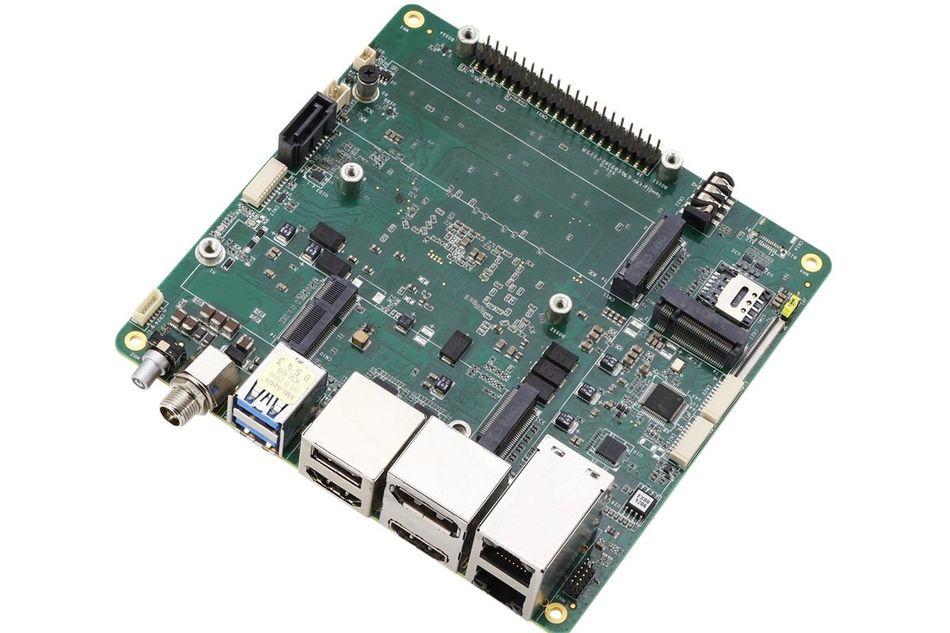
Although the UP Xtreme ARL is only 120.35 x 122.5 mm in size, it has industrial-grade capabilities. Dual-channel LPDDR5-6400 memory up to 64GB, 256GB of storage and Intel Core Ultra 5 or Ultra 7 processors with 14 cores are supported by the board. The integrated Arc 130T GPU performs parallel computation operations with exceptional efficiency and the Intel AI Boost NPU offers comprehensive software framework support for simplified model creation.
UP's emphasis on robotics and autonomous mobile robots (AMR) is revealed from the I/O design. The board has an M.2 3052 B-Key slot for 5G connectivity, two M.2 2280 M-Key slots for NVMe storage or extra accelerators, and an M.2 2230 E-Key slot for Bluetooth 5.2 and Wi-Fi 6E (compatible with Intel AX210 supporting 802.11ac/a/b/g/n + BT5.2, 2.4G/5G/6G). Both 2.5GbE and GbE ports are available for network connectivity and dual USB 3.2 Gen 2 Type-A connectors offer fast peripheral connectivity.
Direct hardware integration is made possible via the trademark 40-pin GPIO header. Industrial communication protocols are supported by dual RS-232/422/485 pin headers. MIPI camera support enables integration of numerous vision systems, which is essential for robotics applications that call for complex environmental awareness. Multi-headed vision systems or intricate visualization situations are made possible by the board's ability to drive up to four monitors at once.
Security features include onboard TPM 2.0 for hardware-based cryptographic operations and secure boot capabilities. Power source unpredictability and vibration resistance—two industrial deployment realities—are addressed by the broad 9-36V DC input range with a lockable DC connection. Both power variations and physical movement can jeopardize conventional connectors in manufacturing settings or mobile robotics applications. No matter the climate, dependable power delivery is guaranteed by the locking jack.
Real-World Applications: Where Theory Meets Practice
The UP Xtreme ARL's 83 TOPS performance opens application possibilities that were previously impractical at the edge.
Advanced Robotics and AMR
The board can achieve up to 83 TOPS of AI performance for the execution of multiple concurrent compute and edge inference tasks, with a foundation capable of handling parallel robotics workloads. The MIPI camera support enables multi-camera vision systems for full environmental perception, while the M.2 5G slot allows for command and telemetry communication. The 40-pin GPIO and dual RS-232/422/485 pin headers facilitate integration with industrial sensors and control systems.
UP has designed the UP Xtreme ARL to power "the next generation of robotics and AMR solutions," with I/O built to support simultaneous robotics workloads. The wide 9-36V power input range accommodates the variety of power sources found in mobile platforms.
Industrial Automation and Quality Control
Manufacturing environments require dependable and real-time inference with low latency. The UP Xtreme ARL can handle numerous video streams at once, allowing for quality inspection, defect detection, and process monitoring. The 83 TOPS performance enables complicated models that can detect tiny flaws that necessitate high-resolution examination across several goods simultaneously.
The sturdy design and industrial-grade components enable reliable performance in industrial deployment circumstances. The locked power connector and vibration-resistant construction ensure dependability even when installed on moving machinery, meeting the demands of industrial situations.
Vision AI and Smart Infrastructure
Smart city applications, traffic monitoring, and security systems are increasingly reliant on multi-camera inference with advanced analytics. The UP Xtreme ARL can evaluate feeds from numerous cameras at the same time, detecting vehicles, license plates, behavior and anomalies in real time.
The four-display functionality enables operator workstations to show live feeds, inference results, alarm summaries, and system health monitoring all at the same time. The dual network interfaces (2.5GbE and GbE) offer high-bandwidth connectivity for demanding applications.
The Complete AI Ecosystem Approach
What distinguishes UP's AI development kits from competitors is the ecosystem's completeness, rather than any single component. Many vendors excel at either hardware or software, but few deliver both with equal completeness. Their approach combines three key components: developer-friendly boards, modular AI accelerators and pre-configured software suites.
At the foundation sit the development boards designed with 40-pin HAT GPIO for hardware expansion and Ubuntu Pro 24.04 pre-installed. This is not a bare-bones Linux installation—each kit includes a comprehensive AI software suite that has already been configured, eliminating the hours of time spent dealing with driver compatibility and framework installation.
The AI accelerator ecosystem offers genuine flexibility. M.2 slots allow developers to combine modules from Hailo (13-26 TOPS), DEEPX DX-M1 (25 TOPS), and Axelera Metis (214 TOPS INT8). This modularity is important because AI workload requirements fluctuate. The project that begins with modest inference requirements might eventually demand higher performance.
The third pillar is represented by camera vision. Though camera integration often becomes a bottleneck, advanced vision systems are becoming more essential for edge AI applications. To resolve this issue, not only does every UP AI dev kit come with a USB HD camera as a default accessory, but UP also addresses this issue through partnerships with several camera vendors supporting both MIPI-CSI-2 and GMSL2 interfaces. ApproPho's GMSL2 cameras provide high-speed data communication across extended distances of up to 15 meters—critical for automotive and industrial robotic applications. Leopard Imaging's MIPI cameras are ideal for developers who prioritize price and ecosystem compatibility. They support a wide range of processors and development boards.
As every project does not require industrial-grade cameras in the beginning, UP recently added support for Raspberry Pi cameras, such as the High Quality Camera (IMX477) and Camera Module 3 (IMX708). This tiered method enables developers to start with cost-effective proof-of-concept hardware before investing in industrial components.
Software: The Often-Overlooked Differentiator
Hardware specs reveal only a portion of the story. The development of edge AI frequently pauses due to software stack integration becoming a time sink rather than a lack of processing capability. To overcome this, UP uses two different software approaches.
Network Optix: Ready-to-Deploy AI Management
Network Optix's NX AI Manager and Toolkit are pre-installed on every UP AI development kit. This is not a stand-in program, but rather a production-grade platform used for managing AI inference and video analytics. With a visual AI pipeline designer that facilitates drag-and-drop model connection and condition-based logic, the system manages object detection, face recognition and video stream processing right out of the box.
The centralized model management is especially useful in multi-device deployments. Through a single platform, engineers can manage model versions, remotely push updates and monitor edge devices. After developing once, you can deploy anywhere with the system's cross-platform deployment capabilities across x86, ARM, and GPU/NPU architectures. Without requiring developers to use a proprietary framework, RESTful APIs and language bindings for Python and C++ allow integration into custom applications.
Network Optix provides a free trial with full feature access for teams looking to verify AI deployment and management features before making a commitment. The seamless interaction with Nx Meta allows for real-time visual confirmation of inference results and system performance, removing the guesswork that is sometimes associated with edge AI debugging.
UP AI Toolkit: Build from Scratch
While Network Optix provides turnkey solutions, UP's proprietary AI Toolkit is aimed at developers who need to create from scratch. This open-source toolkit is available on GitHub and includes three important capabilities that directly solve frequent development bottlenecks.
First, integrated driver and library installation for Intel, Hailo and dedicated GPU platforms allows for one-click environment setup. What used to take hours of reading documentation and resolving dependencies is now only one command. The toolkit automatically configures the Intel AI Boost NPU, Intel Arc GPU, and any installed M.2 accelerator modules, ensuring that all compute resources are immediately available.
Second, the model converter tool converts formats for Intel, Hailo, and dedicated GPU platforms before deploying modified models directly to edge devices. This overcomes a typical stumbling block: models trained in mainstream frameworks require platform-specific optimization before deployment. The toolkit is compatible with TensorFlow, PyTorch, and ONNX models, and it automatically applies hardware-specific optimizations.
Third, the AI benchmark tool allows you to compare the performance of multiple models on the same platform. When deciding between multiple model architectures or optimization tactics, empirical performance data takes the uncertainty out of the equation. This is especially useful on the UP Xtreme ARL, where the 83 TOPS of potential performance may be split across CPU, GPU, and NPU in a variety of configurations. The benchmark tool assists in determining the appropriate computing resource allocation for various workloads.
The Path Forward: Three Tiers, One Ecosystem
Though Edge AI development is accelerating, the fundamental difficulties still remain, including integration complexity, software setup, and production scale. The latest platform reflects UP's decade-long focus on overcoming these gaps. The UP Xtreme ARL AI Development Kit provides 83 TOPS of performance within a full ecosystem designed to take projects from concept to deployment without forcing developers to restart their development process.
The combination of Intel's Core Ultra 225H processors, extensive I/O developed expressly for robotics and AMR applications, pre-configured software suites, and modular expansion possibilities results in a platform that adapts to changing requirements rather than constrains them. The durable, industrial-grade design ensures that the same board used in development can be deployed directly into production applications.
But the ecosystem's strength lies in its tiered approach. UP's current AI development kit portfolio includes three performance tiers, each targeting different use cases while maintaining full ecosystem compatibility. This graduated structure enables developers to match hardware investment to project requirements—starting cost-effectively and scaling up as needs evolve.
UP TWL AI Dev Kit: Entry-Level Intelligence
The entry-level Twin Lake kit, based on Intel's Processor N150, provides a card-sized development platform with 8GB RAM and 64GB of storage. Its 24 EU Intel Graphics deliver adequate performance with just 6W TDP for lightweight edge AI applications like smart sensors, basic object identification and simple classification tasks. The compact form factor and cost-effective design make it perfect for developers to explore edge AI potential or deploy applications where space is limited.
UP Square Pro TWL AI Dev Kit: The Middle Ground
The Square Pro represents a significant step up, with the same Intel N150 processor (6W CPU TDP) but an integrated Hailo-8L AI accelerator (with other AI Accelerator options available to fulfil different needs). This configuration provides up to 13 TOPS of AI performance, enabling real-time analytics and multi-object identification without requiring extra acceleration hardware. The palm-sized form factor remains compact, while expanded AI capabilities enable applications like smart traffic systems, retail analytics, and industrial quality control that require real-time inference.
Seamless Ecosystem Migration
The expandability proves crucial here. A prototype built with the entry-level Twin Lake can validate algorithms and application logic. When performance requirements increase, the same software stack runs on the Square Pro or Xtreme ARL with only configuration changes. The camera interfaces and accelerator slots mean the platform grows with the application rather than forcing complete redesigns.
For engineering teams evaluating edge AI solutions, UP provides a holistic architecture that integrates hardware, software, and extension possibilities. Whether starting with proof-of-concept development with low-cost Raspberry Pi cameras or planning commercial deployment with GMSL2 vision systems and numerous AI accelerators, the platform has tools to meet the ambition of modern edge AI applications.
Those interested in exploring more about the platform can access extensive specifications, documentation, and purchase choices via UP's Shop portal. UP also provides a free Edge AI Toolkit detailed in the Software Tutorial, which allows users to gain instant hands-on experience with object detection, benchmarking, and model conversion operations customized for UP platforms.