Beyond the Hype: What AI Actually Changes for Embedded Software Engineers
AI-ready tools for embedded development evolve how engineers address real-world challenges.

30 Sep, 2026. 4 minutes read

The AI Moment in Embedded Software
There is a gap between the industry narrative of what AI can achieve and the actual constraints of what engineers realistically face. Leaders and the media describe models that can reason, plan, and act with almost total autonomy, while engineers face serious real-world engineering challenges such as code certification, legacy code, and trustworthy AI analysis. This is where most of the authentic conversation about AI in embedded systems happens.
The current development of AI solutions in embedded software is following two distinct paths. The first path is how AI is being applied when embedded software is built, for example through code generation assistants, static analysis tools, or test generation. AI is already performing well in this domain, because the constraints are the same ones that have governed software tooling for decades. AI is good at maintaining accuracy, traceability, and compliance. TASKING has decades of compiler and IDE development focused on driving correct, efficient code, which is a natural foundation for AI-assisted tooling.
At the same time, stakeholders and industry marketers promote a vision that is heavily focused on on-device deployment, such as running complex AI models directly on embedded targets. However, on-device AI in safety-critical systems remains in its early stages. Not every microcontroller requires a neural network or an LLM; in fact, much of what is labeled "AI-enabled" in production today is classic signal processing or a well-tuned control loop under a modern marketing label. While on-device inference is progressing, tools, verification workflows, and AI-assisted development productivity are advancing far more rapidly.
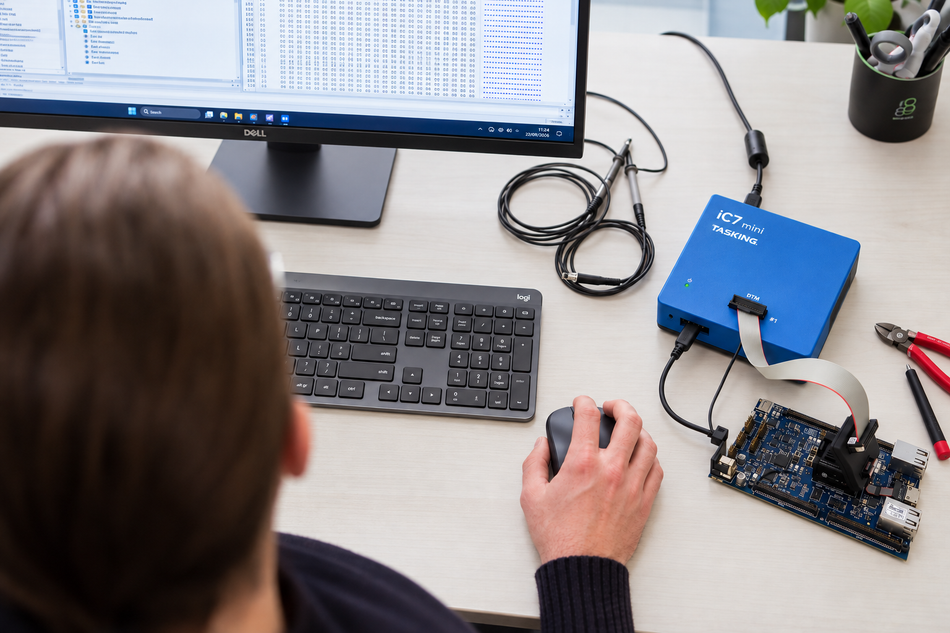 IC7 Mini on the desk. Source: TASKING.Understanding the Engineering Tradeoffs Nobody Can Skip
Embedded engineers have always worked inside the following dimensions: performance, power, memory, and cost. AI adds a fifth dimension that doesn’t sit neatly alongside the other four. Every gain in model capability tends to cost latency, power, or memory, and sometimes all three.
Deploying neural networks on embedded targets requires adapting models to run efficiently within kilobytes of RAM and flash memory. Standard techniques like model pruning and quantization reduce execution precision to lower footprint, but achieving real-time performance on accelerators like vector DSPs depends on toolchain-level optimizations. TASKING’s compiler and tooling ecosystem support this deployment pathway through advanced compiler scheduling, vectorization libraries, efficient memory tiling with DMA transfers, and hardware tracing tools like the iC7 pro—enabling up to a ~70x inference speedup on specialized architectures like the Infineon® AURIX™ TC4x.
Consider a vibration-monitoring node for predictive maintenance. A float32 network works well in a cloud prototype, but the deployed device has a small RAM budget and must run for years on a battery. An int8 model with fewer layers, fed by conventional feature extraction, may score slightly lower on benchmarks and still be the better system: predictable timing, lower power, simpler validation, and a viable bill of materials.
Safety requirements add another layer. For a fixed model graph, inference time is usually quite predictable. More difficultly, outputs are statistical rather than derived from a requirement, which complicates verification, and that timing can still vary with memory contention on multicore devices. Automotive and industrial projects under ISO 26262 and IEC 61508 still need bounded execution time, bounded memory, controlled failure modes, and auditable evidence. Moreover, ISO/PAS 8800:2024 addresses AI in road vehicles more specifically.
In this landscape, the toolchain matters here for a concrete reason. Model converters and inference libraries emit C or C++ that a compiler turns into the final binary. Optimization quality, code-size control, debug visibility, and timing analysis then decide whether the model fits and meets its deadlines. As models shrink to fit hardware, this stage matters as much as the model architecture. TASKING's qualified compilers and libraries are built for it.
TASKING’s toolchain provides compelling value propositions for embedded software engineers. The company offers a strong safety and security ecosystem, which includes certified code-generation tools and libraries. At the same time, TASKING’s broader offerings span debug, trace, test, static analysis, automated testing, structural coverage, and requirements traceability.
AI in Embedded Software Through TASKING's Lens
Everyone involved in the embedded software industry is working through what AI means for their products, and TASKING is no exception. Across their portfolio, that work shows up as exploration into smarter static analysis, AI-assisted development workflows, and tooling built to handle embedded AI targets. These tools are ongoing work, rather than a finished product line.
What stays consistent for TASKING is the underlying discipline. TASKING's compiler, debugger, and test & verification tools exist to produce code that is efficient, traceable, and certifiable, and any AI capability layered onto that portfolio must serve those same goals. Smarter static analysis that catches defects earlier is valuable because it strengthens the certification case, not because it makes the tooling sound more advanced.
AI won't replace deterministic engineering disciplines in embedded systems, and no credible toolchain vendor should suggest otherwise. But what AI will do is change the workflows engineers use to write, verify, and optimize code. TASKING is working to provide engineers with the skill set embedded teams need to keep up. TASKING is a partner for embedded teams navigating the transition, not another voice adding to the hype of idealized, unrealistic AI solutions.
AI is changing how embedded software has traditionally been developed, and a trusted, integrated toolchain is what makes the actual difference within this shift. Explore TASKING's integrated toolchain for AI-ready embedded development to see what that looks like in practice.